
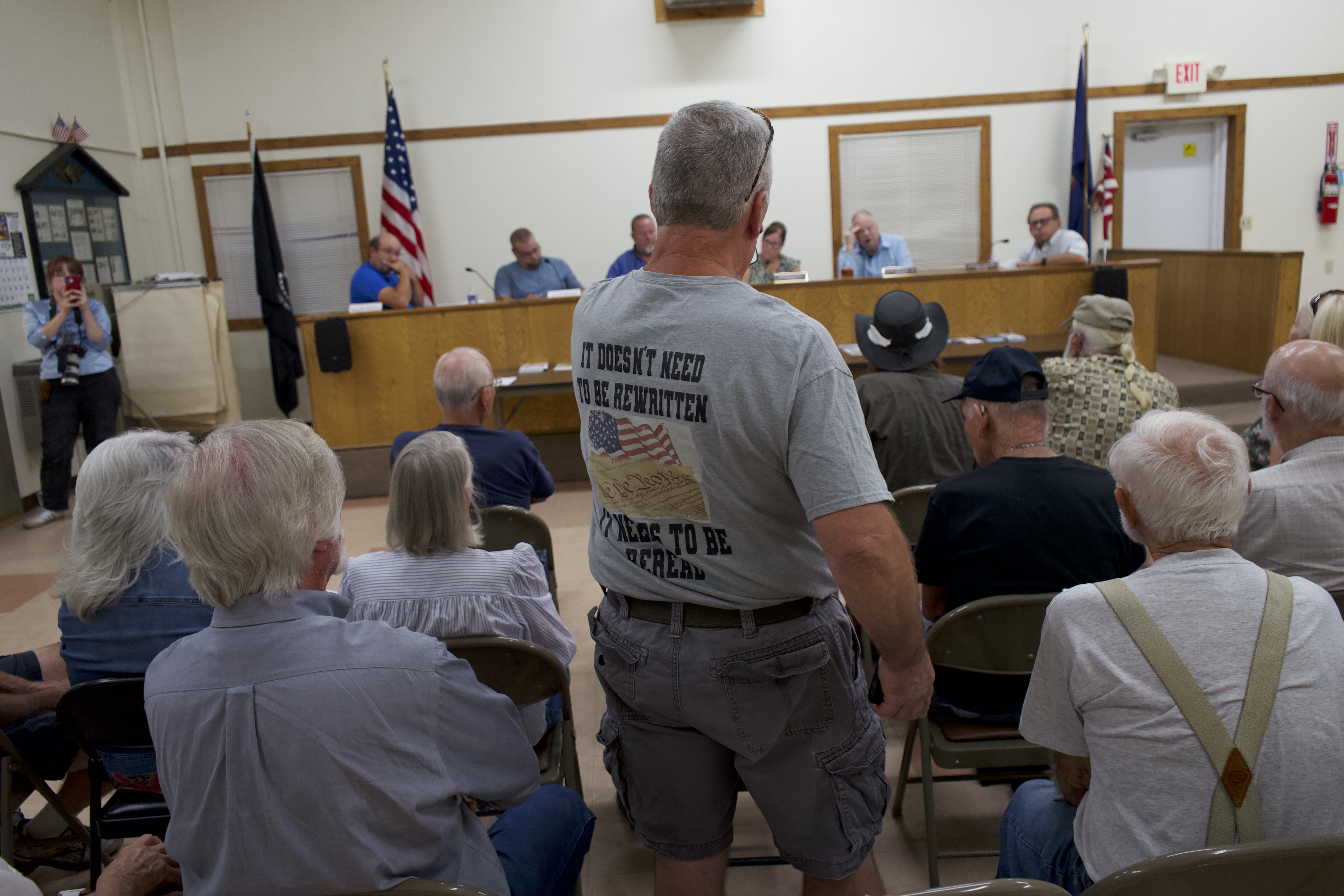

At a packed meeting room in Upper Burrell, Pa., Guy Fuller said he was already worried about all the fracking in his neighborhood. Now, the 77-year-old said he was worried a data center with its own natural gas power plant could be constructed near his house.
“I’m right in the middle of two wells. Now I’m going to have to put up with a data center on top of it?” Fuller said. “A power station?”
Fuller was at a meeting in the Westmoreland County township to advocate against a data center proposed in an industrial park near his house.
Like many communities around the country, Upper Burrell is facing the prospect of a big, power-hungry neighbor that many of its residents say they don’t want.

“Seventy-five percent of the people across America are against data centers being put in their residential neighborhoods,” said Fuller, citing recent data. “They don’t want them. Neither do we. We don’t want it in Upper Burrell.”
Putting the brakes on data center development
In May, the township supervisors enacted a six-month moratorium on data centers; with the deadline approaching, the township is writing a data center ordinance to regulate their operation within its borders.
The ordinance applies to a project by the Florida-based AI data center company TECfusions, which wants to build a large facility on a 1400-acre former Alcoa research and development site in Upper Burrell. When it announced the purchase of the site in November, 2025, TECfusions also noted the $2 million in subsidies the project received from Pennsylvania, through the state’s Redevelopment Assistance Capital Program.
At full buildout, the company says its data center could consume 3 gigawatts of electricity, enough to power a small city. But right now the data center is operating at a small fraction of that.

Residents at the meeting talked about their worries over the data center’s potential noise, water use, and its impact on electricity rates.
At one point township supervisor chairman Ross G. Walker, III asked for a show of hands of those in favor or opposed to the data center.
Almost everyone in the crowd of around 50 were opposed.
Among them was Dave Ostrowski. He said that his father worked at the site when it housed Alcoa’s Research and Development center. Alcoa employed 1,600 workers then. Ostrowski told the board he was skeptical that a data center, which doesn’t need many workers to run, would contribute much to the local economy.
“My dad worked for Alcoa for many years,” he said. “Alcoa brought a lot of good things to this community. And the bottom line is I don’t get that vibe from these guys.”
Writing a law to limit data center impacts
The township’s ordinance covers many of the areas that Pennsylvania Gov. Josh Shapiro’s recently announced Governor’s Responsible Infrastructure Development (GRID) standards hope to accomplish.
It sets a minimum 500-foot setback from property lines, and 1,000 feet from residentially zoned areas. It mandates that any new data center provide its own power, and sets guidelines for fire protection, water use, noise limits, lighting and visual screening. The subject has consumed the town in recent months, said supervisor Ken Slahtovsky.

“I wake up in the middle of the night, turn my phone on, and read (about) data centers,” said Slahtovsky. “Because that’s all that’s on my phone these days.”
Slahtovsky said there are limits to how much the township can regulate data centers.
“From what our solicitor’s said, we cannot ban it,” he said. “And my personal viewpoint is I don’t want to drag the township in a legal battle where we can’t afford to battle it.”
Slahtovsky said from his vantage point, fracking companies operating in the township have been better than the data center.
“They were showing up at meetings. They were answering questions,” he said. “I have not got much out of TECfusions.”
TECfusions did not respond to requests for comment.
Gilian Graber, executive director of the environmental group Protect PT, says the local government should be aggressive in regulating the data center. Residents there are already dealing with truck traffic, dust and noise from fracking operations there.
“When we spoke to residents of Upper Burrell, they were really mad at the fact that the local government has not even addressed the impacts of fracking,” said Graber. “And now they’re welcoming in another type of developer that’s going to have a whole other (set of) impacts.”
Graber’s organization is appealing the municipality’s decision to allow the data center under its current zoning code.
(Protect PT receives funding from the Heinz Endowments, which also supports the Allegheny Front.)
One of those residents is John Mataldi, who lives near two gas wells and a pipeline, and across the street from the data center.

“My neighbor is encroaching on my rights, is the way I look at it,” Mataldi said.
The proposed ordinance caps noise at 75 decibels, around the level of a city street or a running lawnmower.
“That is a very loud noise with no barriers in place. I live 1,000 yards from the building. No barriers, there’s one row of trees,” Mataldi said.
A broader backlash
Hannah Wiseman, a law professor at Penn State University and co-director of the Penn State Center for Energy Law and Policy, said communities around the country are revolting against the buildout of data centers.
“Communities are shouldering most of the burden of this race,” Wiseman said. “There are certainly national benefits of data centers and of AI. But communities are not feeling many of those benefits. They’re shouldering the burden of a national economic boom. And often they’re not getting compensated for that burden.”
Wiseman said the opposition to fracking in some communities in Pennsylvania bears some resemblance to the backlash to AI. But there are also differences.
With natural gas, many were concerned about the local environmental impacts of fracking on water wells and air quality, but there was also support because rural landowners were benefitting from leasing their land to gas companies.
“There are…a lot of benefits to private property owners in the case of natural gas because there were so many leases,” Wiseman said. “When it comes to a data center, you’ve got a few landowners who will benefit from selling their property and the data center companies are offering unbelievable quantities of money to these land owners. But it’s fewer landowners who will benefit.”
One way to ensure a community benefits from a data center would be through a strong community benefits agreement, Wiseman said. This is a bargain a developer strikes with a local government in exchange for permission to build in an area.
Communities can get clean energy commitments, cash, and commitments to limit their water-use.
“They can get extensive benefits,” Wiseman said. “The sky’s the limit because data center companies want to build so badly and so quickly. I think communities don’t fully realize their negotiating power.”
The Upper Burrell supervisors say they’ll negotiate a benefits agreement after they have their data center ordinance in hand. A deadline for the ordinance is November 2.