


Anxieties have been rising in Springdale as the borough north of Pittsburgh debates whether to welcome a data center to the site of a former coal-fired power plant.
The borough council plans to make a decision at its Dec. 16 meeting, after collecting hours worth of evidence from Allegheny DC Property Company, which hopes to build the data center.
Allegheny DC has already bought the property where the former Cheswick Generating Station sat. County records show the sale closed on Nov. 19, two days after the borough’s planning commission voted to recommend the borough council approve a conditional use permit for the site.
The planned 565,000-square-foot building could be about seven stories tall, including cooling equipment on the roof. It could demand as much power at one time as more than 140,000 homes.
Since the permit application was filed in August, people in town have been looking for answers about their potential new neighbor, and in some cases, trying to stop it from moving forward.
From coal plant to data center: An Allegheny County community voices concern
‘It will just never end’
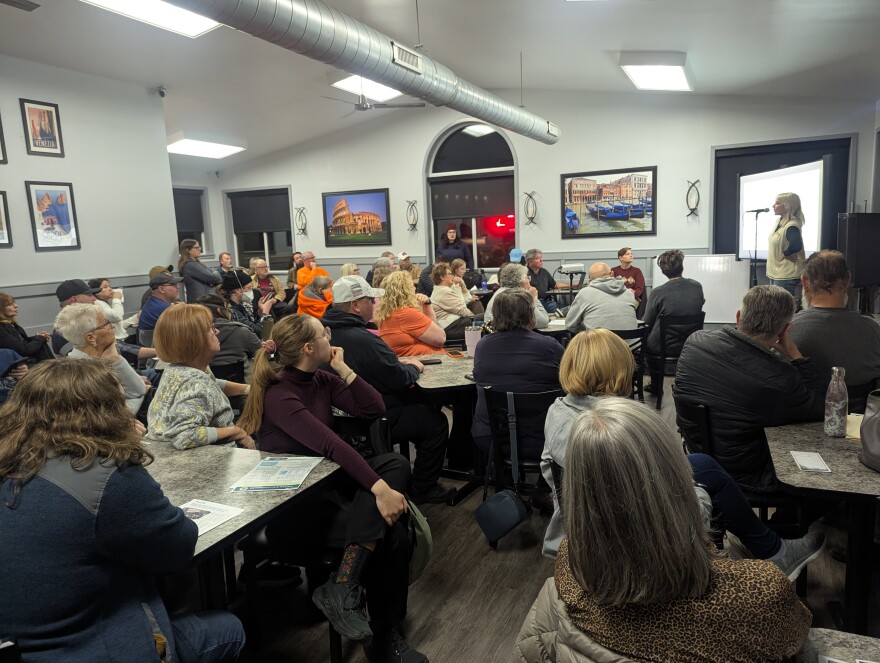
More than 75 people packed into the main dining room of the From Italy restaurant in mid-November to hear a presentation from environmental group Protect PT on data centers. Members of the group filled a white board with questions from the audience on topics ranging from water use and noise to other potential uses for the site.
Restaurant owner Chuck Cickavage said he jumped at the chance to host the town hall, since his schedule doesn’t allow him to go to many borough meetings.
He’s concerned the huge draw of power to the site will mean more power outages for the rest of town, affecting small businesses like his.
Cickavage’s pizza shop has its own generator, but it still had to close for a week earlier this year when a big storm knocked out power in the region. He said insurance only pays a percentage of lost revenue during such events.
Cickavage also lives one block from the former power plant. He bought his house in the late 80s, when he said the noise from the plant was occasional.
“Every once in a while they would vent their boilers or whatever, and it was just this really loud noise. And that happened maybe once or twice a month,” he said.
Now the prospect of living in the shadow of a massive data center has Cickavage worried.
“ The noise will be never ending. Once it starts and they light this plant up, it will just never end,” he said.
The noise is one of the main worries people in town bring up.
Allegheny DC Property Company said sound modeling shows that noise will be well below the borough’s limit of 85 decibels, even when backup generators are running.
On an average summer day, the company said the sound level will be similar to a refrigerator hum at the property line.
Data centers need to stay cool to protect the expensive computers inside. The fans can create a constant hum or buzz.
That off-site noise can affect people’s quality of life, said Chris Miller, president of Piedmont Environmental Council, which has been tracking data center growth in northern Virginia.
“Constant background noise, often at frequencies that are very upsetting to pets,” Miller said. “There’s some scientific evaluations of the frequencies that suggest that they’re associated with fight or flight responses, biological responses, so it causes anxiety in certain species and certain people.”
Miller said complaints from people who live near the new centers generally include construction traffic, the buildings not fitting with the character of neighborhoods, noise, and air pollution.
The pollution mainly stems from the backup generators data centers have on site to ensure around-the-clock operation. Miller said 90% of the generators used run on diesel. During a power outage, all of those generators can kick on at once.
“Neighbors report noise and emissions,” Miller said. “Because there’s no monitoring in place, it’s hard to know what the air quality effects really were.”
Allegheny DC has not decided what type of generators it will use.
Miller said the explosion of these warehouse-like buildings without much explanation in neighborhoods that were thought to be “suburban heaven” makes people feel betrayed.
“ It’s a violation of trust. It’s getting worse and it’s happening in more places, and the scale of it is getting bigger, and so the public upset is growing” Miller said.
Public process
In Springdale, people have been able to meet with representatives from Allegheny DC and listen to their testimony at public meetings. But several have complained that the process doesn’t feel open.
Though information was presented in open meetings, the borough council deliberated privately ahead of their scheduled vote. Borough Manager Terry Carcella said that private meeting was because the council sits “in a quasi-judicial capacity in a Conditional Use proceeding.”
Melissa Melewsky, Media Law Counsel for the Pennsylvania NewsMedia Association, said while the use of executive session during quasi-judicial deliberations is allowed under the state’s open meetings law, it’s not required.
“The borough can have this discussion publicly, they are choosing to exclude the public. The question is why, especially with an issue like this one,” Melewsky said.
Carole Brennan, who joined a recent protest outside the former plant, said the borough council is only listening to experts provided by the company.
“ When I go to those meetings, I feel like someone is trying to sell me a timeshare,” Brennan said.
She said the company’s experts make it sound like the center will be “wonderful.”
“They build it, they scoot out of town and it’s not wonderful and we have to live here,” Brennan said.
She doesn’t want the borough to replace the coal plant with another thing that she says could hurt the environment, through its water use and reliance on fossil fuels for energy.

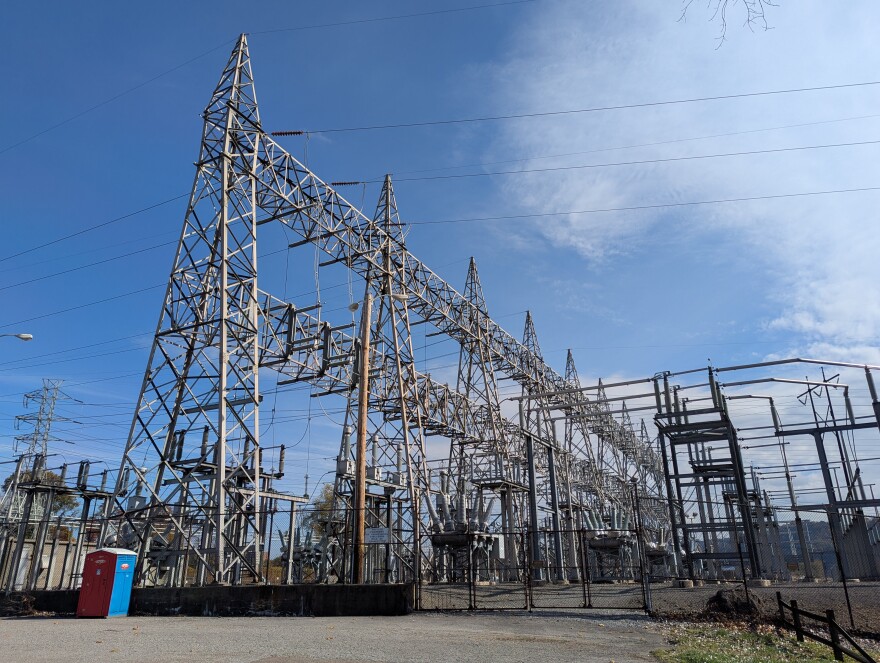
Allegheny DC has said it will use a closed loop system for cooling that will limit the amount of water it will use.
However, data centers can use water both directly and indirectly, said Andy Yencha, a water resources educator with Penn State Extension.
Water is used directly on site for cooling. Indirect use comes from electricity consumption.
“Most of the power plants providing energy for data centers rely on evaporative cooling as well,” Yencha said. “So, they lose a lot of water to evaporation to produce that power; two, three or more times as much as a data center might use directly.”
If more data centers on the electric grid means power plants need to ramp up to meet demand, that means they will also use more water.
Brennan, a retired psychotherapist, has lived in Springdale for more than 50 years. She doesn’t know if she could move or where she would go, especially since she believes the new data center would impact all the surrounding communities, not just Springdale.
But it’s only Springdale that has a say on how the site is permitted.
The permit up for a vote is mainly concerned with the physical qualities of the project: noise, lighting, landscaping, height. The borough gives little input on environmental or utility impacts.
But those issues caused several residents to speak out during a recent public comment opportunity.
James Binnix, who moved to Springdale a few years ago, said people should be thinking about the impact on their electric bill.
Rates have already been going up. An analysis from Carnegie Mellon found electric rates increased by as much as 40% in some areas over the past five years, with data centers named as a main driver. Hot spots for the centers, such as northern Virginia, could see rates rise by another 25% in the next few years.
Binnix said rising bills along with other issues could drive people out of town, possibly giving an opening to slumlords.
“Completely just dismantling the idea of a small town community in general, or maybe just even turn[ing it] into a ghost town,” Binnix said.
Binnix’s fiancé, Kailyn Wood, said she’s hopeful the borough is listening to residents and that they might have a say in how the center is monitored and how its parent company could give back to the community.
Chris Miller, with Piedmont Environmental Council, said that kind of engagement is important.
“ The idea it’s a redevelopment of an industrial site is a positive, but that doesn’t mean there aren’t potentially incremental negative impacts that could be addressed and mitigated if you plan for them,” Miller said.
If for some reason the council does not vote before Dec. 31, and the end of the council’s term, the issue will need to start over again with a newly seated council.